SpectraSherpa
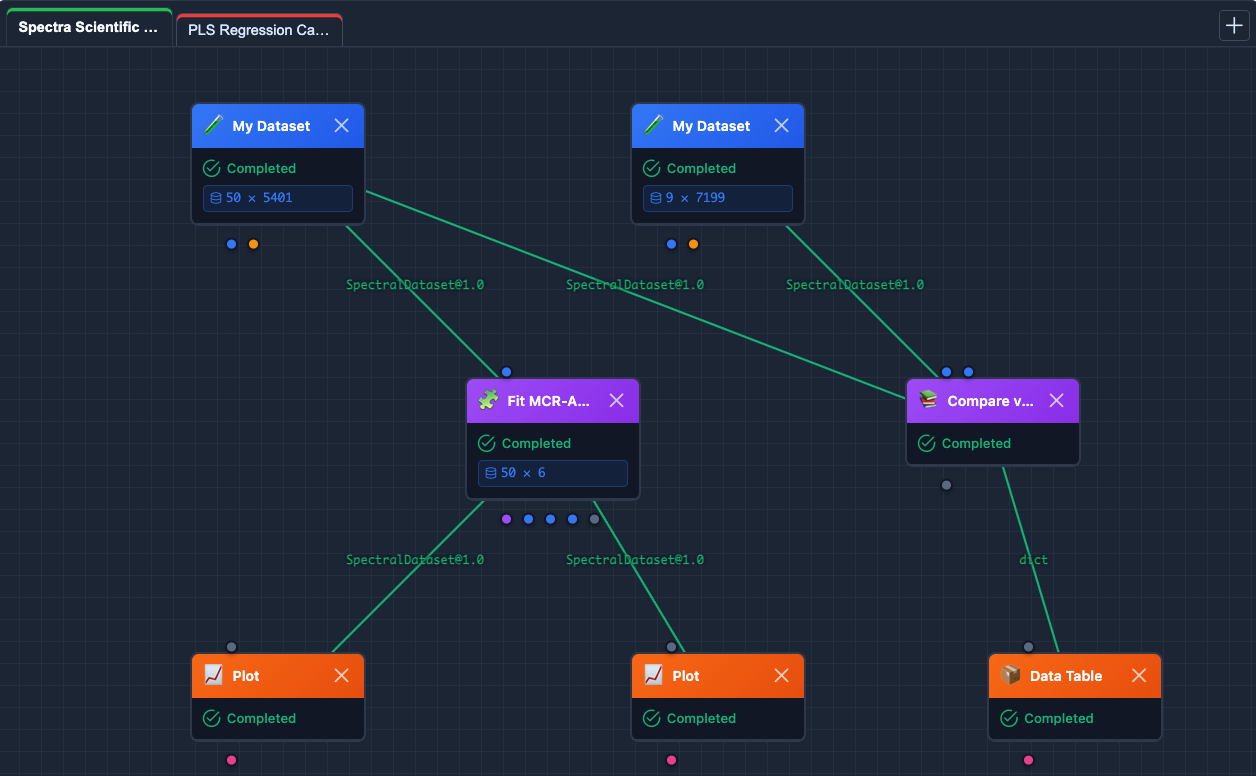
Go from raw FTIR, NIR, Raman, or UV-VIS files to a reviewable PCA result, calibrated model, or classification workflow in your browser. SpectraSherpa carries file provenance through the workflow: import files, inspect the data matrix, preprocess spectra, run chemometrics, save models, and export results.
Hosted trial availability
The 0.6 hosted trial is available for evaluation on its supplied starter project and qualified registered-reference path. For customer-owned data, use Local OSS, Subscription Cloud, or Enterprise Hybrid.
Choose Your Path
| Goal | Start Here |
|---|---|
| Try the hosted product quickly | 5 Minutes to Spectra Sherpa Cloud |
| Run locally with your own data | 10 Minutes to Local Compute |
| Bring in a file and check provenance | Import Your First Dataset |
| Check supported file formats | Supported File Types |
| Review built capabilities and boundaries | Current Capabilities |
| Build or contribute to the OSS repo | Developer Setup and Contributing |
What Is Built
SpectraSherpa is designed as a spectroscopy application, not only a collection of numerical routines. It combines GUI-first workflow building, transparent import provenance, spectroscopy-aware data structures, reproducible workflow graphs, chemometrics templates, model outputs, validation plots, reports, exports, NIST references, and optional HITRAN/HAPI synthesis. Vendor readers are exposed only after native qualification; see Current Capabilities for the full grounded scope.
Cloud and AI Assistance
Sherpa Advisor and Ambient Guidance are optional scientific assistance layers. Advisor answers questions about workflows, plots, preprocessing choices, and reports; Ambient Guidance offers contextual next-step suggestions inside the app. They are labeled aids for scientific review, not replacements for spectra, metadata, validation design, or domain judgment. See Cloud vs Local OSS for AI configuration and risk guidance, and Demo Access and Limits for public demo policy.
Scientific Foundations
SpectraSherpa builds on scientific software and data maintained by the broader community, including SpectroChemPy, NIST, HITRAN/HAPI, NumPy, SciPy, pandas, and scikit-learn. Cite upstream resources when they contribute to your analysis.